Floating Floors and Vibration Isolation: Why a Quiet Test Room Needs More Than Thick Walls
A low background-noise target is rarely lost through the walls — it is lost through the floor. Structure-borne vibration is what separates a room that looks soundproof from one that measures quiet. Here is how floating floors and vibration isolation actually work.
Buyers often judge an acoustic room by its wall thickness. But once airborne noise is handled, the limit on how quiet a room can get is usually structure-borne: vibration travelling through the building slab into the room, re-radiating as sound inside. Thick walls do nothing about it. This is why a room that looks soundproof can still fail a low dBA target.
Airborne vs structure-borne noise
Airborne noise travels through the air and is blocked by mass and sealing — the walls and door. Structure-borne noise travels through solid connections: the floor slab, conduits, anything rigidly coupling the room to the building. Compressors, AHUs, forklifts and neighbouring machines all pump vibration into the slab. If the room is bolted straight to that slab, it hears them.
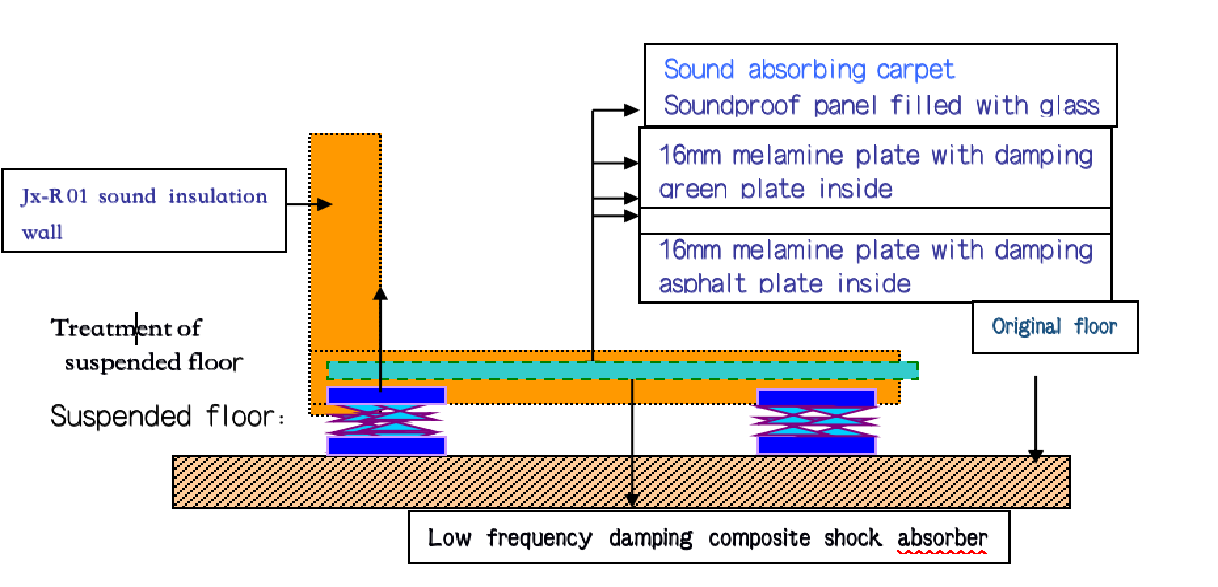
The floating floor
A floating floor sits the room on resilient isolators — springs or engineered elastomer mounts — so the room structure is mechanically decoupled from the building slab. Vibration entering the slab is largely reflected at the isolation layer instead of passing into the room. The heavier the floating mass and the softer the isolator, the lower the frequencies it controls.
Isolators and resonant frequency
Every isolation system has a natural (resonant) frequency. Above it, isolation improves; near it, vibration is amplified. The design target is a natural frequency well below the disturbing frequencies you need to block, so the system isolates across the range that matters. Choosing and distributing isolators to hit that target — under a real, uneven load — is the engineering, not the catalogue.
Decoupling the whole room
For the lowest noise floors, the floating floor is paired with a full room-in-room build: walls and ceiling are also decoupled, penetrations are flexibly sealed, and ducts are silenced and isolated. The room becomes a mass-spring system floating inside the building, not a box attached to it.
Why it matters for your dBA target
If your target is ≤30 dBA or lower, vibration isolation is usually the deciding factor, not wall mass. Specify the disturbing sources around the site (HVAC, lines, traffic) so the isolation can be designed for them — and accept the room on an on-site measured number with the surroundings live, which is the only test that captures structure-borne paths.
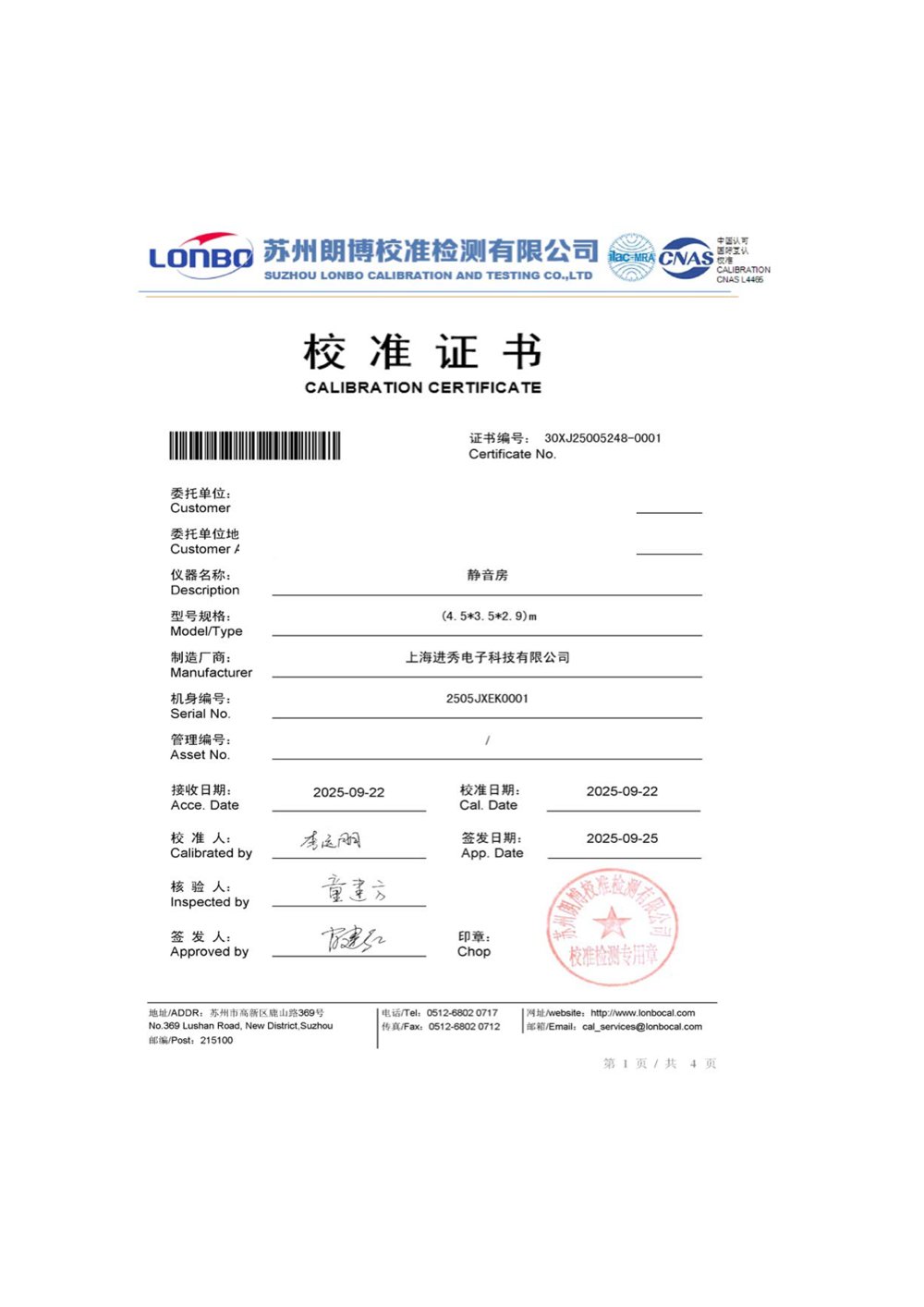
Jinxiu builds room-in-room floating structures on vibration isolators as standard, and accepts every room on a measured dBA. Delivered projects have measured as low as 9.7–18.6 dBA in real customer plants.